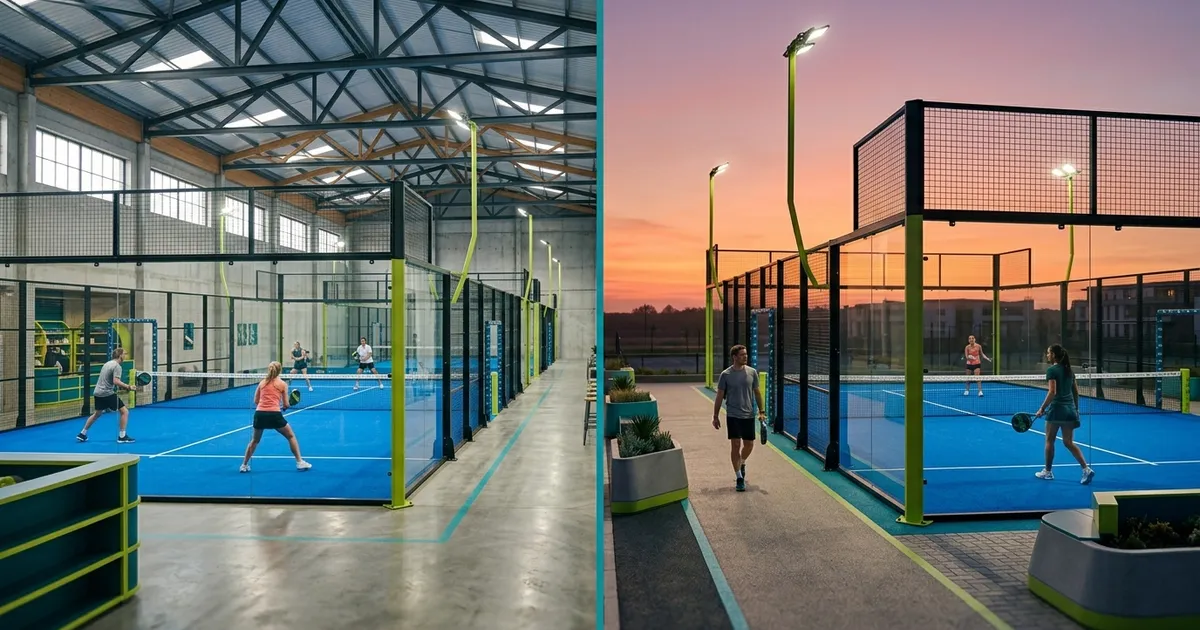
After location, the biggest decision a new padel club makes is whether its courts go indoors, outdoors, or under a roof somewhere in between. It shapes your budget, your opening timeline, how many hours you can sell each year, and how your neighbors feel about you.
There is no single right answer. There is a right answer for your climate, your site and your budget. This guide lays out the trade-offs for owners in both the US and Europe.
The short answer
- Outdoor is cheaper and faster, and works well in warm, dry climates, but you lose hours to weather and darkness and face more noise risk.
- Indoor costs far more, but gives year-round, predictable play and protects you from both weather and most noise complaints.
- Covered outdoor (a canopy or roof without full walls) is the middle option: protection from rain and sun at a lower cost than a full building.
The market is moving indoors. In the US, 42% of padel courts are now indoor, up from about 39% a year earlier, according to Misitrano Consulting's US Padel Report 2026. In Italy, one of Europe's two largest markets, roughly 45% of courts are indoor.
1. Climate and playing hours
A padel court only earns money when someone can play on it.
Outdoor courts lose hours to:
- rain (turf and glass become slippery and unsafe)
- cold winters and short daylight in northern Europe, the UK, Canada and northern US states
- extreme heat in places like Texas, Arizona or southern Spain in midsummer
- wind, which makes lobs and wall play unpredictable
Indoor courts keep their hours. Every evening in January sells the same as an evening in June. That predictability matters for leagues, memberships and coaching programs, because regulars expect their weekly slot to happen.
A rough rule: if your climate gives you mild, dry weather most of the year (much of Spain, Florida, southern California), outdoor can work. If it does not, indoor or covered courts are much safer for a business that needs steady income.
2. Build cost
Indoor costs more, and the building is usually the largest single cost.
Ranges published by US builders and industry sites in 2026 look roughly like this:
| Option | Typical range per court (US) |
|---|
| Outdoor court, all-in | about $40,000–$75,000 |
| Canopy or fabric cover over an outdoor court | about $50,000–$85,000 extra |
| Indoor court, court only | about $70,000–$100,000+ |
| Building, HVAC and fit-out (indoor) | separate, often the biggest cost |
European costs differ by country, but the pattern is the same: the court kit is the smaller part, and the structure around it is the larger part. Treat all these figures as planning ranges and get several local quotes.
3. Ceiling height and buildings
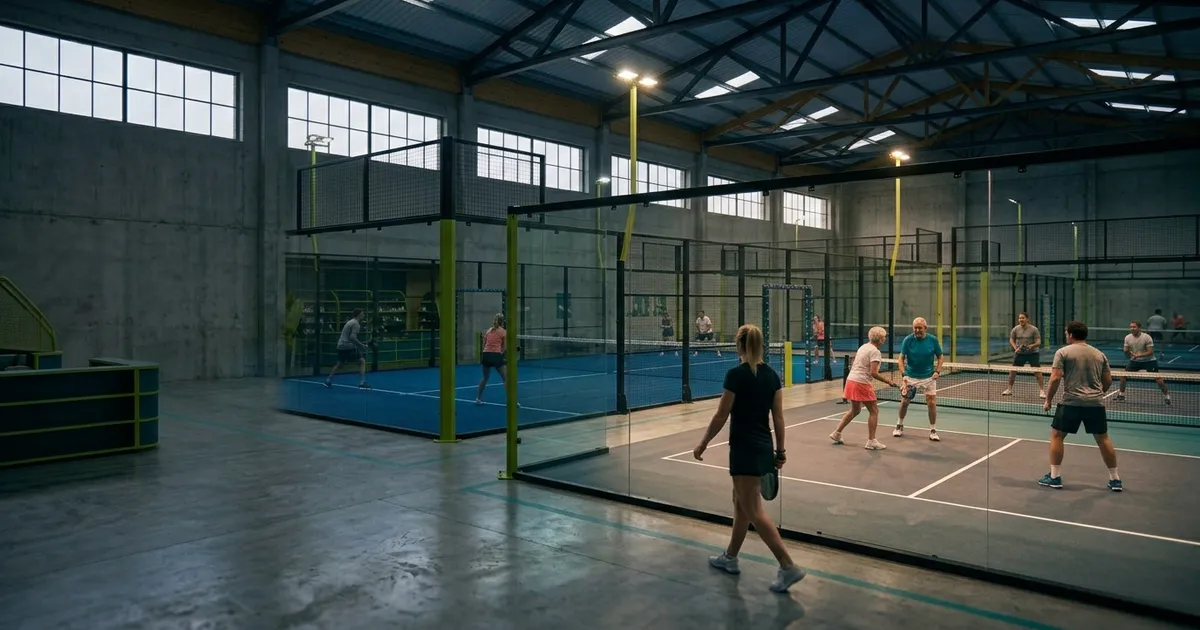
Indoor padel needs a tall building. The regulation minimum clear height is 6 meters (about 19 ft 8 in), and 7–8 meters is recommended for new clubs. Many warehouses look tall but have beams, ducts or a pitched roof that cut the usable height. See our full breakdown in Padel Court Dimensions in Feet and Meters.
Conversions of warehouses, industrial units and old sports halls are the most common route into indoor padel. They can be fast and affordable, but rent is a long-term commitment. Sweden's padel bust was partly driven by clubs signing expensive leases on industrial buildings during the hype and then struggling to fill them. We cover that in What Sweden's Padel Bust Teaches New Club Owners.
4. Noise and planning permission
This is the factor most new owners underestimate.
Padel is louder than tennis. The solid racket and the ball hitting the glass create sharp, repeated impact sounds that carry, especially outdoors and especially in the evening when neighbors are home.
In the UK, noise has become a real planning issue:
- In Sheffield, a tennis club's padel court was taken out of use after the council served a noise abatement notice, and the club withdrew its retrospective planning application. A council report described padel noise as "impulsive, repetitive and intrusive."
- In Harrogate, a leisure club's two outdoor courts were refused retrospective planning permission after residents complained about noise, leading to a long dispute and a revised application.
- Several other UK councils have refused or restricted outdoor padel applications near homes.
The issue is not limited to the UK. The Netherlands, for example, applies a maximum noise level for individual ball strikes in its guidance for padel near homes.
What this means for your decision:
- Outdoor courts near houses carry real planning and operating risk.
- Indoor courts in commercial or industrial areas avoid most of it.
- If you build outdoors, commission a proper noise assessment early, consider acoustic barriers, choose sensible closing times, and talk to neighbors before you apply.
5. Lighting
Outdoor courts need floodlights to sell evening hours, which are the most popular hours. Floodlights often need their own planning approval and can trigger complaints about light spill.
Indoor courts need good, even overhead lighting that does not dazzle players looking up for lobs. Plan lighting with the court manufacturer rather than treating it as an afterthought.
6. Running costs
| Cost | Outdoor | Indoor |
|---|
| Rent or building costs | low (land only) | high (building) |
| Heating, cooling, ventilation | none | ongoing |
| Weather damage and cleaning | higher (leaves, sand, rain) | lower |
| Lighting | floodlights for evenings | lighting most of the day |
| Lost revenue from weather | can be significant | minimal |
Outdoor clubs spend less to stay open but sell fewer reliable hours. Indoor clubs spend more but sell more of their hours. Which one comes out ahead depends on your climate and how full your courts are.
7. Player experience
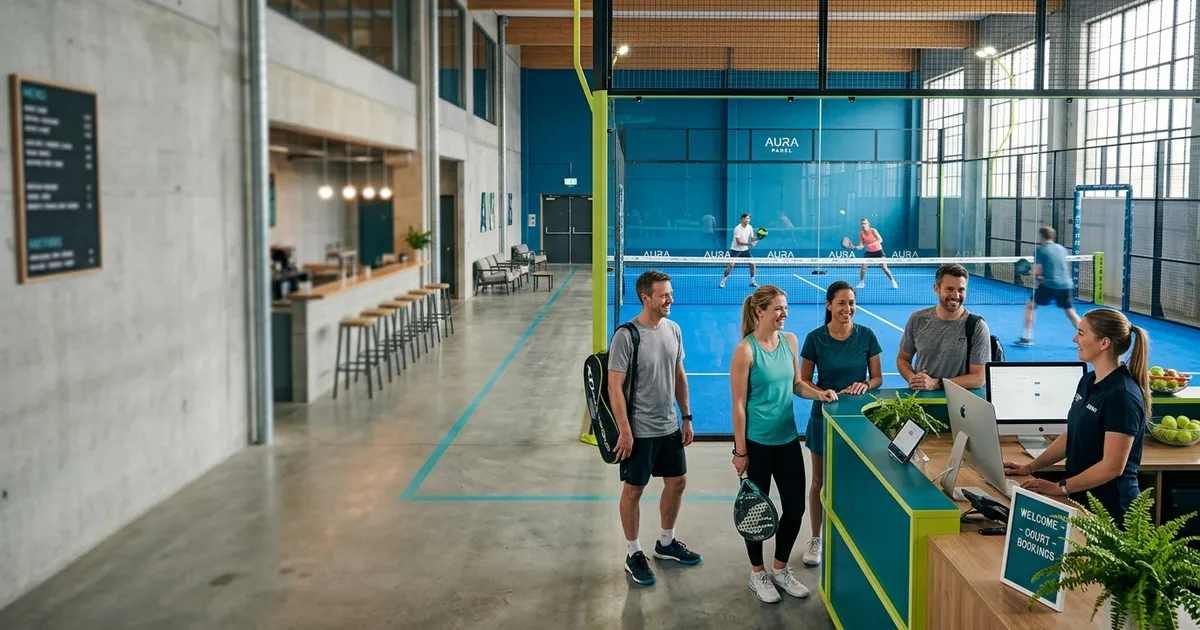
Indoor clubs usually feel like a destination: a reception desk, a lounge, a café, changing rooms. That makes it easier to build community and sell memberships, coaching and drinks.
Outdoor courts can feel fantastic on a warm evening, especially at hotels, resorts and tennis clubs. Many players love playing outside.
Which should you choose?
Choose outdoor if:
- your climate is mild and dry for most of the year
- your site is away from homes
- you are adding courts to an existing tennis club, hotel or resort
- you want a lower-cost way to test demand
Choose indoor if:
- you are in the UK, northern or central Europe, or a US state with real winters or extreme summers
- you want a standalone club built around leagues, memberships and coaching
- your best site is in a commercial or industrial area
- predictable year-round income matters more than a low build cost
Choose covered outdoor if:
- rain is the main problem, not cold
- you want weather protection without the cost of a full building
Frequently asked questions
Are indoor padel courts worth the extra cost?
In cold, wet or very hot climates, usually yes, because they protect your playing hours and your neighbors. In mild climates, outdoor courts can make good sense.
Can I convert outdoor courts to indoor later?
Sometimes, with a canopy or a new building around them, but it is easier to plan for it from the start, including foundations and ceiling height.
Do indoor courts need planning permission?
Usually, for the building or change of use. Rules differ by country and city, so check with your local authority early.