Two racket sports are fighting for the same square footage. Pickleball has exploded across the US. Padel has taken over much of Europe and is now growing fast in America too. If you run a tennis club, gym, sports center or empty warehouse, you have probably been asked which one to build.
This guide compares them from an owner's point of view, not a player's. It covers space, construction, demand, programming and the case for running both.
The quick comparison
| Padel | Pickleball |
|---|
| Court size | 20 × 10 m (65 ft 7 in × 32 ft 10 in) | 20 × 44 ft (6.1 × 13.4 m) |
| Recommended total area per court | about 2,153 sq ft of play area, plus the wall structure and access | 34 × 64 ft (2,176 sq ft) for new construction |
| Enclosure | glass and mesh walls, part of the game | none needed; fencing or nets between courts |
| Build complexity | specialist court kit and installation | surface, lines and nets; can use existing floors |
| Typical format | doubles | doubles and singles |
| Strongest market | Spain, Italy, wider Europe; growing in the US | United States; early stage in Europe |
Space: closer than you think
Here is a surprise for many owners: a padel court and a well-planned pickleball court take up almost the same floor area.
- A padel court's playing area is 200 m², or about 2,153 sq ft.
- USA Pickleball recommends a total playing surface of 34 × 64 ft (2,176 sq ft) per court for new construction, with a minimum of 30 × 60 ft (1,800 sq ft).
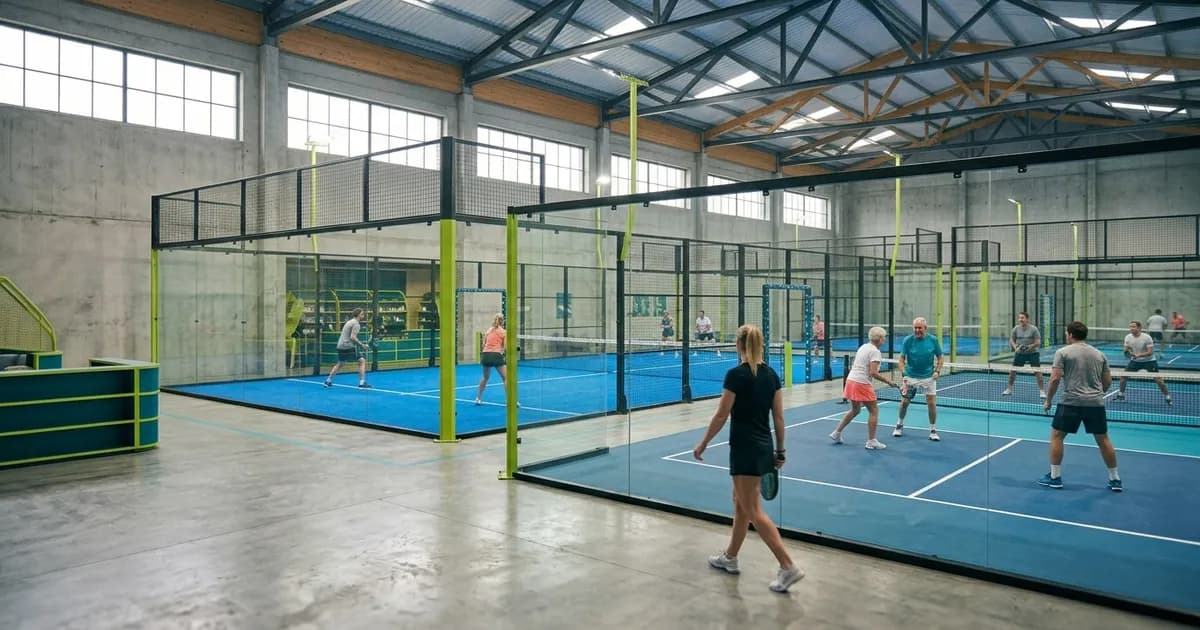
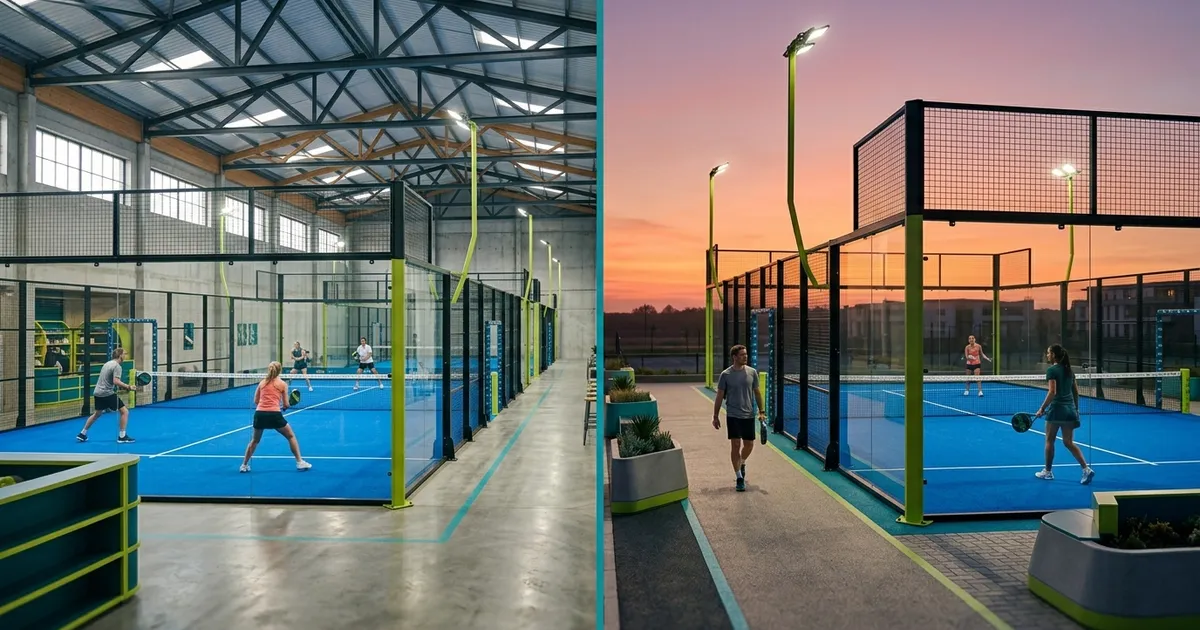
The difference is what goes on that space. Padel needs a fixed glass-and-mesh enclosure plus room outside it for the structure and doors. Pickleball needs only a surface, lines, a net and run-off space.
On a standard tennis court footprint, you can typically fit about three padel courts or about four pickleball courts, depending on layout.
Construction and cost
Pickleball is cheaper and more flexible to build. It can be played on concrete, asphalt, sport tiles or a gym floor. Many venues simply paint lines on existing tennis courts or indoor halls and add portable nets.
Padel needs a specialist build. You need a level slab, a manufactured glass-and-steel court kit, synthetic turf with sand infill, and lighting. US industry estimates for 2026 put an outdoor padel court at roughly $40,000–$75,000 all-in, with indoor projects higher before the building itself. Once built, a padel court is permanent and can only be used for padel.
That makes pickleball the lower-risk way to test demand, and padel the higher-commitment, more specialized investment.
Demand in the US
Pickleball is already mass-market in the US. USA Pickleball's 2025 report counted more than 18,000 places to play across the country, from public parks to private clubs. Players expect to find courts nearby, and a lot of the supply is free or low-cost public courts.
Padel is smaller but growing much faster from a low base. The US had 1,110 padel courts across 38 states in Q2 2026, up 61.6% in a year, according to Misitrano Consulting's US Padel Report 2026. In many US cities there is no padel club yet, which means less competition for the first operator.
For a US owner: pickleball has more players but more competition, including free public courts. Padel has fewer players but less supply, and players are used to paying for premium private courts.
Demand in Europe
Padel is the established sport in Europe. Spain and Italy are mature markets with thousands of courts each. France added more new courts than any other country in 2025. In the UK, around one million people now play padel and the number of courts has grown quickly.
Pickleball in Europe is earlier. It is growing, and international events are arriving: the PPA Tour launched a European circuit for 2026–27, and the English Pickleball Open in 2026 used more than 60 purpose-built courts. But dedicated pickleball facilities are still rare. In much of Europe, people play on shared badminton or sports-hall courts with temporary lines.
For a European owner: padel is the proven, bookable product today. Pickleball can be a low-cost addition, especially in sports halls, but it is less proven as a standalone business.
Player profile
The two sports overlap but attract slightly different crowds.
- Padel tends to skew younger and more athletic, and is fast-paced and social. It is popular for after-work bookings, leagues and corporate events.
- Pickleball is famously easy to learn and spans all ages, with a strong base among older adults and families.
Many facilities find the two audiences complement each other: pickleball can fill daytime hours with retirees and families, while padel fills evening peak slots with working professionals.
Programming and revenue
Both sports earn money in similar ways: court rental, coaching, leagues, tournaments, memberships and social events. The difference is how players like to play.
- Padel is usually booked as a court for a fixed group of four, plus organized matches and leagues.
- Pickleball has a strong culture of open play and drop-in sessions where players rotate in and out, alongside court rental.
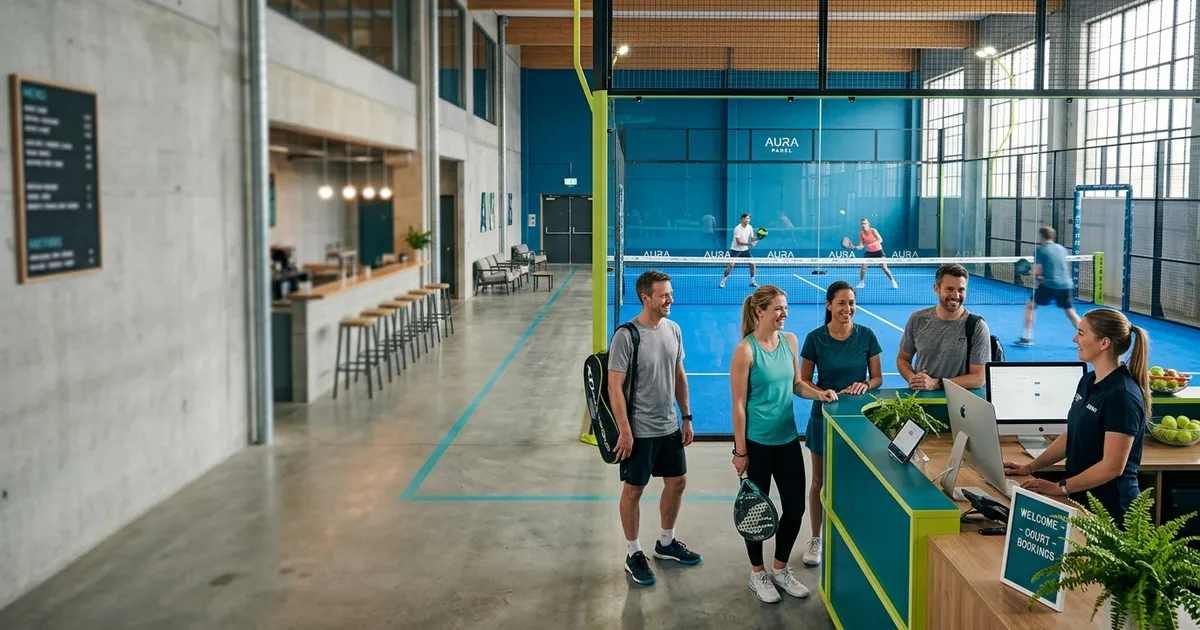
Your booking system needs to handle both private court bookings and recurring programs, and give staff one clear view of who is on which court.
Noise
Both sports are noisy compared with tennis. Padel's ball hitting solid rackets and glass has led to planning refusals and noise abatement notices for outdoor courts near homes in the UK. Pickleball has its own well-known noise disputes in US neighborhoods. For either sport, outdoor courts near houses need a noise plan before you build.
Should you build both?
For many multi-sport venues, the answer is yes.
Running both makes sense if:
- you have enough space for several courts of each
- you want to fill daytime and evening hours with different audiences
- you want pickleball as a low-cost entry point and padel as a premium product
Choose padel only if:
- you are in Europe, where padel demand is proven
- you are building a premium, membership-led club
- there is little or no padel nearby
Choose pickleball only if:
- you are in the US with strong local pickleball demand
- your budget is limited or you want to convert existing courts cheaply
- your space cannot support padel's ceiling height or enclosure
Frequently asked questions
Is padel or pickleball more profitable?
It depends on your market. Pickleball is cheaper to build but often competes with free public courts in the US. Padel costs more to build but players are used to paying for premium court time. Local supply and demand matter more than the sport.
Can one court be used for both?
Not in practice. A padel court's enclosure and turf are built only for padel. Pickleball lines can share a tennis court or sports hall, but not a padel court.
Which sport is growing faster?
Both are growing quickly. Pickleball is far larger in the US. Padel is far larger globally and is growing fast in the US from a smaller base.